

What It Is
The JS Agentic Framework is the AI-Native business operations framework we use to run our business and other do the same.
In November 2025 we shipped JS Agentic: a no-code way for a small business to stand up custom AI agents against its own content in under thirty minutes. We described it then as a “composable architecture” that “handles orchestration,” because that was the most precise language available.
Through 2026 the field converged on a better word. LangChain published The Anatomy of an Agent Harness in July. Databricks benchmarked coding agents and found cost per task varied by more than 2x depending on which harness ran the model, holding the model constant. In August, NVIDIA’s AVO result prompted TechCrunch to call the harness, not the AI model, the real hero.
We have updated our vocabulary to align with the evolving landscape. Two names, two different things:
- JS Agentic Harness — the product. The execution substrate. What runs.
- JS Agentic Framework — the method. How you run it, and how it gets better.
This document defines the second. It replaces the Agentic Project Management (APM) framework created in September 2025.
Five Components
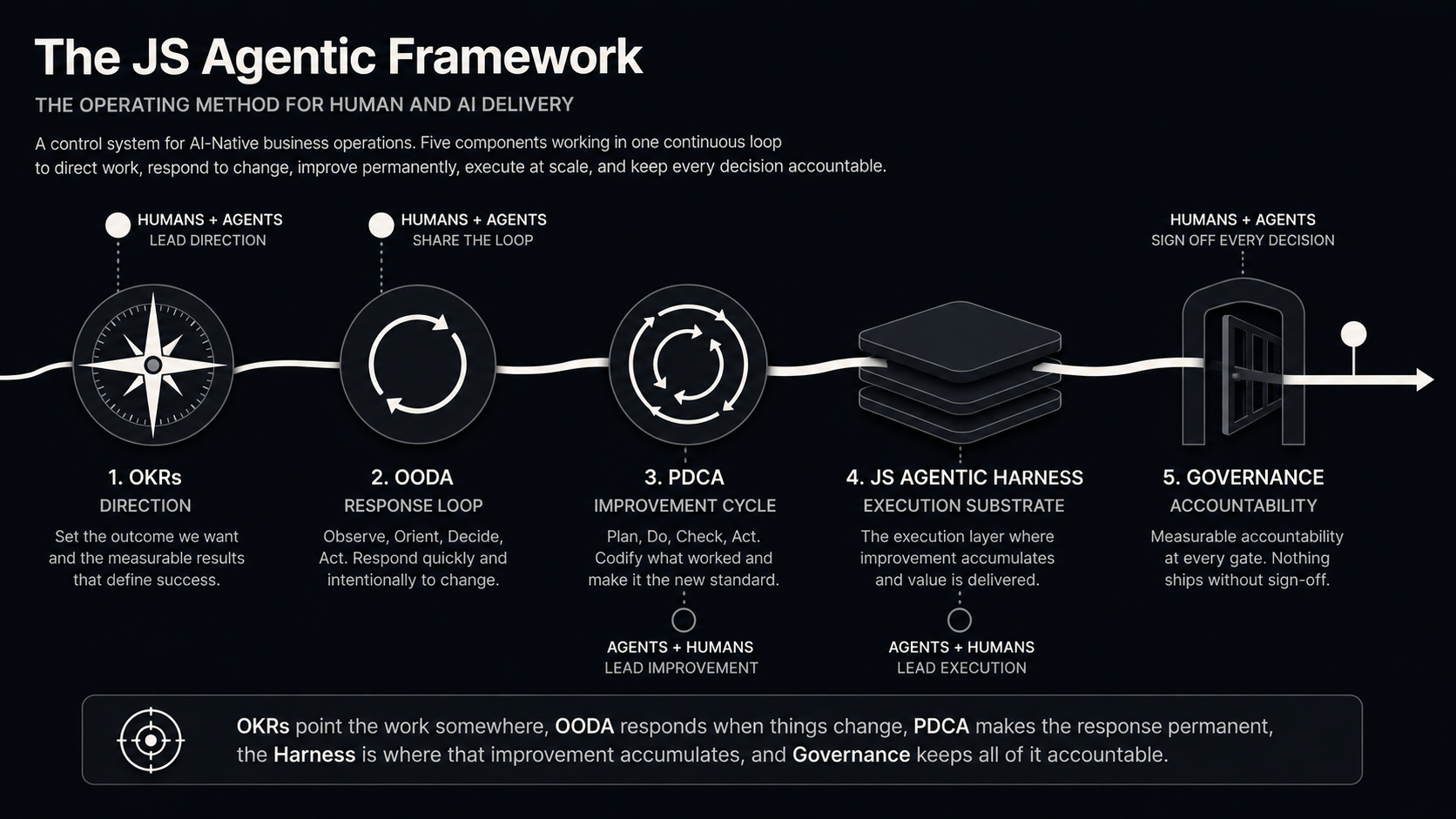
The Framework is a control system, not a checklist. Each component does a job the others cannot.
| Component | Role | Authority | Cadence |
|---|---|---|---|
| OKRs | Direction — what outcome, measured how | Humans + Agents | Minimum quarterly |
| OODA | Response loop — observe, orient, decide, act | Humans + Agents | On significant change |
| PDCA | Improvement cycle — codify what worked | Agents + Humans | Per cycle |
| JS Agentic Harness | Execution substrate | Agents + Humans | Continuous |
| Governance | Measurable accountability at every gate | Humans + Agents | Every decision point |
In one sentence: OKRs point the work somewhere, OODA responds when things change, PDCA makes the response permanent, the Harness is where that improvement accumulates, and Governance keeps all of it accountable.
To control quality, costs, and speed, decision Authority has to be intentional. As an AI Augmentation company, nearly every human task is agent-assisted, and every agent task is intentionally guided. Nothing here is done by humans alone or by agents alone, and nothing runs without measurable outcomes. What the column records is who holds content or process authority — and the name listed first is the one that leads.
This distinction is an important part of the design. Direction, response, and accountability are led by people, because those judgment calls are tied to real monetary consequences. Improvement and execution are led by agents, because those are volume work that compounds. Getting the pairing backwards is a common way AI adoption fails: businesses delegate the judgment and keep the volume, then wonder why the output is wrong and expensive.
OKRs — Direction
Objectives and Key Results answer what we are trying to achieve and the measurements that tell us we achieved it. Agents are relentless executors; without a stated objective they will optimize something, just not necessarily the thing that matters. Without Key Results they cannot measure whether the achievement is real.
Humans hold content authority for Objectives and their Key Results. Agents assist throughout — drafting, refining, pressure-testing whether a Key Result is actually measurable, and reporting against it — but they do not decide what the business is for. The OKR is the difference between agents that are busy and agents that are useful.
OODA — The Response Loop
The OODA loop (Observe, Orient, Decide, Act), developed by military strategist John Boyd for real-time decision-making, is how the Framework responds when conditions change. Humans hold process authority here; agents do a great deal of the work inside it.
In practice the loop is shared. Agents observe continuously and surface what moved. Agents help orient — pulling the history, running the comparison, laying out the options. The decision is the human’s, and the action that follows is executed by both.
It fires on significant change, not on a schedule: a Key Result that misses, a cost that moves, a model release that shifts what is possible, a client priority that turns.
The decision stays with a person for a specific reason. Agents are fast and literal, and they will pursue a Key Result long after the Objective stopped being the right one. Agents are very good at telling you the Key Result is slipping; deciding that the Objective itself is now wrong is a different act, and it is the one a business must keep.
A note on levels. OODA is scale-free; Boyd applied it from the cockpit to the command. Our Architecting the AI-Native SMB report maps OODA onto an agent’s internal ReAct pattern — the micro-level reasoning behind each tool call. Both readings are correct at their own altitude. In this Framework, OODA names the command loop where humans hold decision authority; the agent’s tactical loop runs inside the Harness, underneath it.
PDCA — The Improvement Cycle
The PDCA cycle (Plan, Do, Check, Act) is W. Edwards Deming’s contribution and the reason this Framework improves rather than merely repeats. Where OODA is how the business responds to change, PDCA is how that response becomes permanent.
This is a loop agents can lead. They are better at it than we are: reading execution history at volume, spotting the failure pattern that recurs across forty runs, and proposing the procedure change that removes it. Our AI-Native SMB report describes exactly this — analysis agents running over historical logs, detecting failure patterns, and updating the guardrails so the same error cannot happen twice. Humans hold approval authority over what gets codified; agents do the finding and the drafting.
The critical step is the second Act: what worked gets written back into the harness as a codified procedure. A fix applied once is a fix. A fix written into the harness is a capability. This is what turns a year of agent work into compounding institutional knowledge instead of a year of one-off rescues.
That report also covers why reliability follows the “march of nines” and why deterministic systems engineering — not better prompts — is what crosses it.
The JS Agentic Harness — Execution
The harness is everything around the model: memory design, supervisor logic, context management, tool access, and codified procedures. Agents run inside it; humans design and tune it. It is where the work of the improvement cycle accumulates.
Two properties matter commercially:
It is portable. The harness is assembled on open standards — Model Context Protocol for tool and data access, AGENTS.md for project context, Agent Skills for procedural knowledge, Agent Plugins for packaging — stewarded by the Agentic AI Foundation under the Linux Foundation. Your memory design and codified procedures stay yours when the model underneath changes, and it will change.
It decides your bill. Harness quality shows up on the invoice before it shows up anywhere else. See Same Model, Better Harness for the cost evidence.
Practically: the JS Agentic Harness deploys custom agents in under thirty minutes, runs on consumption-based pricing, and works with the workspace a business already has. It carries no dependency on any single vendor’s platform. What it is and how it works.
Governance — Measurable Accountability
Governance enables running the framework safely within the business.
It has three parts:
- Human decision gates. Humans set the outcome and hold the sign-off; agents execute and prepare the evidence for review; nothing moves forward without a person accepting it. Speed with oversight exactly where it counts — as demonstrated here, where a production-ready solution shipped the same day it was scoped, human-validated at every stage.
- Evidence over prose. An agent claiming something works is not evidence that it works. Validation produces artifacts — test output, cost reports, diffs — not assurances.
- Auditability. Every change is traceable to a decision, an owner, and a reason. This is ordinary change-management discipline; agentic speed makes it more necessary, not less.
Governance is also where ethical AI deployment lives: what agents may touch, what data they may see, and what always requires a person.
What We Built On
Nothing here is invented. The Framework composes practices that have empirical evidence behind them:
| Source | What it contributes |
|---|---|
| Scaling and Agile practice | Work breakdown, cadence, flow, and the coordination patterns behind 150+ teams and 30+ ARTs |
| Lean | PDCA itself, plus constancy of purpose — Deming’s argument that survival is optional and change is not required |
| Agentic AI Foundation | The open standards that make harness work portable rather than a sunk cost |
| Systems engineering | Reliability as an engineering property: bounded workflows, strict interfaces, fast feedback |
| Software engineering and CI/CD | Automated validation gates, contract tests, and fail-closed checks that run before anything ships |
The novelty is not in the parts. It is that these parts are usually available only to organizations that can afford a platform team, and the harness is what puts them within reach of a business with fifteen people.
The Outcome
The Framework has one objective: efficient AI-Native adoption and operation across the organization.
This changes what a business is capable of, not just how fast it moves. Companies modernizing with structured AI adoption see 2.5x higher revenue growth and 2.4x greater productivity, with 15-25% reductions in operational costs. Our own operations run a full agentic team on the daily news engine for under $0.33 a day, and our Agentic Memory Bank reduces multi-agent coordination overhead by 60-70%.
Small businesses leveraging this Framework are able to bring technical work that used to be bought back in-house. Website changes, integrations, reporting pipelines, automation — the work that previously meant a vendor, a statement of work, and a six-week wait becomes something the team does itself. Staff upskill from AI-Resistant to AI-Curious to AI-Native, and the capability stays in the organization.
We are quantifying that saving against named vendor baselines before we publish a figure. What we will say now is the qualitative claim, because it is the one our clients recognize immediately: the Framework does not just make your existing work cheaper, it makes work possible that you previously could not do at all.
Adoption Path
- Set one OKR. One objective, two or three measurable key results. Pick a workflow that hurts.
- Stand up the harness against that workflow. Under thirty minutes; use the Workspace you already have.
- Define the gates before you need them. Where does a human sign off? What counts as evidence?
- Let the agents run. They work the task inside the harness. Watch where they stall.
- Respond to change. When a result misses or conditions shift, run OODA. Let agents surface what moved and lay out the options; make the call yourself.
- Codify what worked. Every cycle, run PDCA. Let agents find the recurring pattern and draft the fix; approve what gets written back into the harness.
- Widen. The second workflow is materially cheaper than the first, because the harness already knows how you work.
Want to see what this looks like in your business? Let’s talk.
Sources
- The Anatomy of an Agent Harness — LangChain
- Benchmarking Coding Agents on Databricks’ Multi-Million Line Codebase
- Nvidia just showed that the harness, not the AI model, is now the real hero — TechCrunch
- Agentic AI Foundation (Linux Foundation)
- Model Context Protocol
- AGENTS.md — An Open Format for Guiding Coding Agents
- Agent Skills — Overview and Specification
- Agent Plugins — Open, Vendor-Neutral Plugin Standard
- OODA Loop
- Plan-Do-Check-Act