



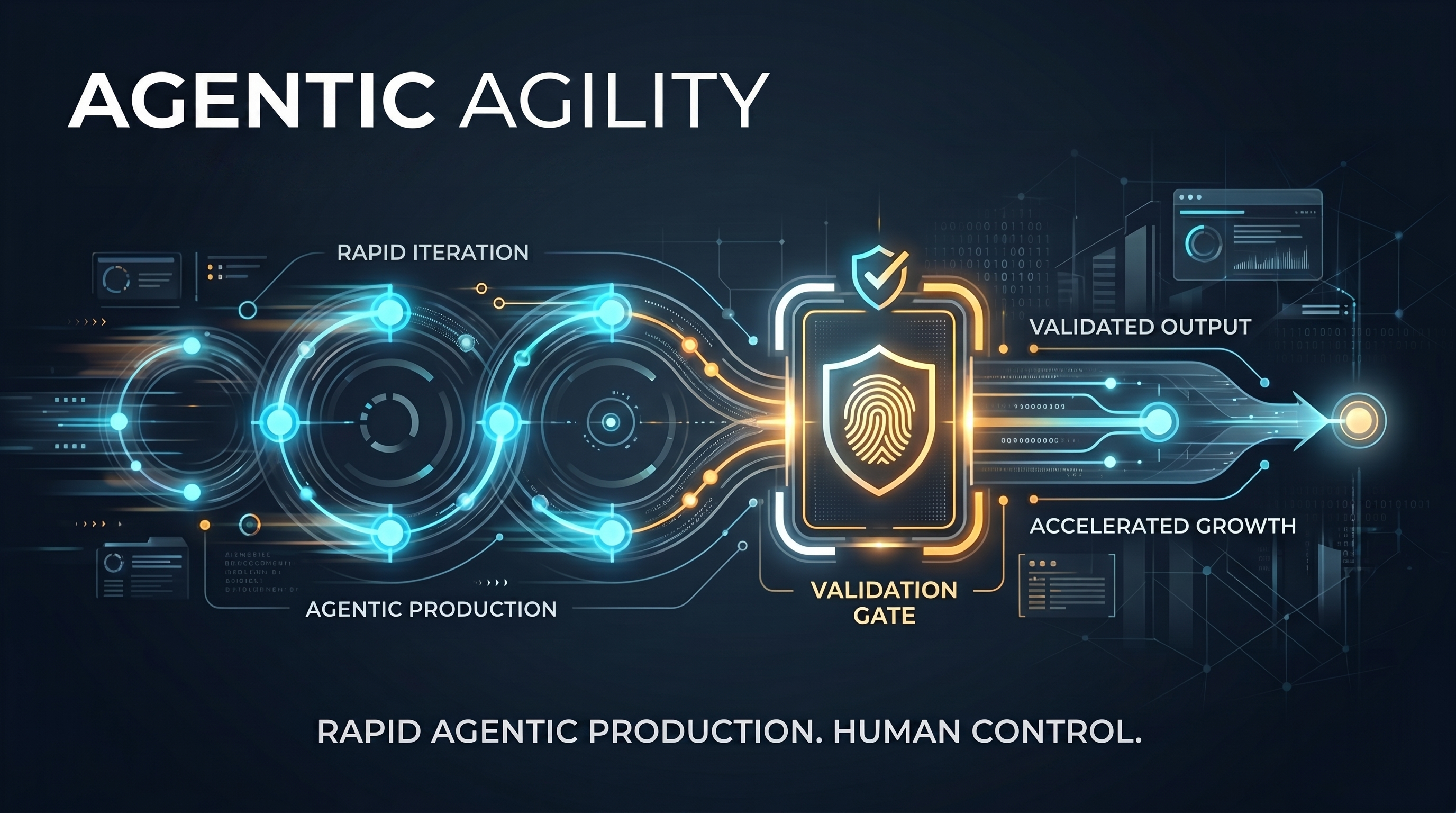
One week. New client. Real pressure. Real results.
Clarify the actual deliverable. Protect the business with payment and contract gates. Adapt to leadership changes mid-sprint. Deliver on time.
And then the part worth talking about: the solution was scoped, built, QA tested, and deployed to production in a single day.
Not a prototype. A production-ready, human-validated solution — same day. Every stage ran human-in-the-loop: agents executed the workflow, humans validated at the decision gates, nothing moved forward without sign-off. That is not speed without control. That is agile supercharged by agentic iteration — a pace no human-only team can match, with oversight exactly where it counts.
This is what it looks like when you stop experimenting with agents and start running your business on them.
The System Behind It — Agentic Relentless Improvement
At Jeffrey Stop, every client engagement, every workflow, every improvement loop runs through JS Agentic — an agentic orchestration platform we built, operate, and continuously improve. When a new engagement comes in, agents handle intake, contract gating, artifact tracking, and delivery-readiness checks. Humans direct. Agents execute. The system checks in where judgment is required.
That is not a pilot. That is how we work.
And it compounds. After delivery, we run agentic retrospectives — what worked, what created drag, what should be codified. We immediately turn those improvements into reusable agentic skills and plugins that codify lessons learned into workflow rules, artifact states, escalation logic, and validation scripts. These artifacts ship back into JS Agentic, improving the platform with every cycle.
JS Agentic is more capable today than it was after the last sprint. That is the point.
The 2026 Reality Check
Gartner reports that 40% of enterprise applications will include task-specific AI agents by end of 2026 — up from less than 5% last year. An 8x jump in twelve months. And yet Axis Intelligence reports that 88% of agent pilots never reach production. The gap between launching an agent and running your business on one is where the real competition is happening.
Microsoft’s 2026 Work Trend Index identifies the highest-value human-agent collaboration mode as the Orchestrator — someone who designs systems of parallel agents running entire workflows end-to-end. Only 16% of AI users operate at that level today.
IBM Think 2026 found that only 25% of AI initiatives deliver expected ROI. IBM CEO Arvind Krishna: “The enterprises pulling ahead are not deploying more AI — they’re redesigning how their business operates.”
Grant Thornton’s 2026 AI Impact Survey puts a number on it: organizations with fully integrated AI are nearly four times more likely to report revenue growth than those still piloting — 58% versus 15%.
The discipline gap, not the technology gap, is what separates the leaders from the rest.
What It Takes to Build and Maintain This
Harvard Business Review published two pieces this year worth bookmarking. The first argues that agents must be treated like digital employees: defined scope, bounded authority, trusted data sources, clear execution controls, and audit trails. The second introduces the “agent manager” role — a human responsible for how agents learn, perform, and improve over time.
The retrospective is how we fulfill both. Atlassian describes it as the most reliable mechanism for continuous improvement that small teams have — and we treat it as the heartbeat of our agentic operating model. Skip it, and the learning evaporates. Run it, and the learning becomes the system.
Three Things to Take From This
1. Close the pilot-to-production gap. Pick one real workflow and commit to running it with agents through a full sprint. The value lives in production, not in demos.
2. Treat your agents like team members. Define the role, bound the authority, keep the audit trail. That is how you maintain a system — not just launch one.
3. Turn every retrospective into a codified asset. A skill, a plugin, a checklist — something that ships back into your system. Capturing the learning is not enough. It has to compound.
The businesses that win are not the ones with the most agents.
They are the ones that redesigned how they work around them — and built systems that improve every sprint.
If you want to build an agentic operations model that ships to production the same day — let’s talk.
Sources
- Gartner Predicts 40% of Enterprise Apps Will Feature Task-Specific AI Agents by 2026
- Agentic AI Adoption Statistics 2026 — Axis Intelligence
- 2026 Work Trend Index Annual Report — Microsoft
- IBM Think 2026: Blueprint for the AI Operating Model — IBM Newsroom
- 2026 AI Impact Survey — Grant Thornton
- To Scale AI Agents Successfully, Think of Them Like Team Members — Harvard Business Review
- To Thrive in the AI Era, Companies Need Agent Managers — Harvard Business Review
- What are agile retrospectives? — Atlassian
- Meet JS Agentic: Your Small Business Just Got an AI Team — Jeffrey Stop