



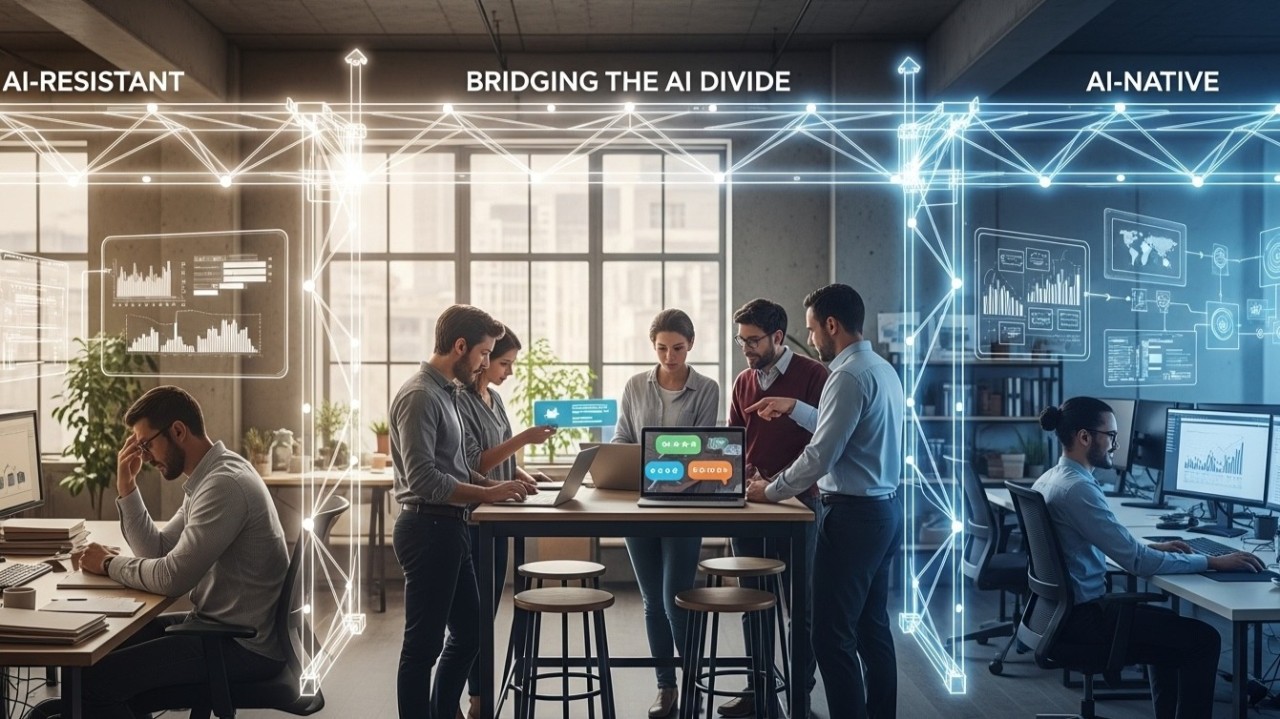
AI-Native | AI-Curious | AI-Resistant: Which Group Are You In?
Walk into any small business today and you’ll see it: a productivity divide emerging between those who’ve embraced AI and those who haven’t. Some people seem to be flying—they’re more productive, handling complex problems faster, somehow getting more done with the same hours in the day. Others are curious but stuck, asking questions about AI but not sure where to start. And then there’s a third group: skeptical, unconvinced that all this AI buzz is of any value.
We believe a three-tier workforce phenomenon has developed, and it’s defining a competitive advantage.
AI-Native | AI-Curious | AI-Resistant
Larridin Russ Fradin defines the three groups as:
AI-Native have embraced tools like ChatGPT or Claude and woven them into their daily workflow. They produce more output, solve more complex problems, and leverage technology in ways unimaginable two years ago.
AI-Curious employees recognize AI’s importance but haven’t found their breakthrough use case. They’ve experimented with prompts, but the tools haven’t clicked yet. They need direction, training, or simply permission to invest the time to learn.
AI-Resistant workers haven’t seen compelling evidence that investing time in AI will pay off. They’ve tried a few basic prompts, got mediocre results, and concluded AI isn’t for them.
The challenge is the productivity gap between these groups widens every week. And for small businesses, where every team member’s contribution directly impacts the bottom line, you probably can’t afford to have two-thirds of your workforce falling behind.
The Small Business AI Divide
The good news? Small business AI adoption surged to 58% in 2025, up from 40% the year before. The gap between large enterprises and small businesses is closing fast.
The concerning news? Only 31% of workers report receiving any AI training from their employers, even though 77% expect AI to affect their career within five years.
This training gap creates a vicious cycle. Without structured guidance, your AI-Curious employees stay stuck. Your AI-Resistant employees become more entrenched in their skepticism. Meanwhile, your AI Natives are self-teaching in isolation, developing workflows the rest of your team never sees.
Over 68% of enterprise AI usage happens on unapproved, free-tier accounts where employees work alone. That means most organizations have no visibility into which AI applications actually work, making it impossible to scale what’s successful.
Why This Matters More for Small Businesses
You might be thinking: “Isn’t this an enterprise problem?”
Actually, it’s more critical for small businesses. Here’s why:
In a 500-person company, if 30% of employees become AI-proficient, that’s 150 people driving innovation. In a 15-person company, 30% means just 4-5 people. You need everyone contributing at their highest level.
The organizations modernizing with AI are seeing 2.5× higher revenue growth and 2.4× greater productivity, with 15-25% reductions in operational costs. But these results only come when AI adoption is intentional, structured, and supported by proper change management.
The Real Solution: Architecture, Not Just Training
Most small businesses approach this challenge the wrong way. They buy AI tool licenses, send a few training videos, and hope something sticks.
That’s not enough.
What works is treating AI adoption as organizational transformation, not technology deployment. That means:
1. AI Strategy & Assessment Understanding where your team actually is—not where you hope they are. Which employees are your AI Natives? What workflows have they developed? What barriers are stopping your AI-Curious employees from breaking through? Why are your AI-Resistant employees unconvinced?
2. Workforce Architecture Building structured pathways that move employees from curiosity to competence to mastery. This includes identifying high-value use cases, creating guardrails for safe experimentation, and establishing feedback loops so successful patterns can be scaled across the team.
3. Change Management That Sticks Organizations that invest in change management are 1.6 times more likely to report that AI initiatives exceed expectations. AI adoption isn’t just about tools—it’s about shifting mindsets, building trust, and demonstrating tangible value quickly enough to sustain momentum.
4. Agentic Teams Architecture The future isn’t human-only or AI-only. It’s agentic teams where specialized AI agents work alongside your human workforce 24/7/365, handling repetitive cognitive tasks so your team can focus on strategy, relationships, and high-value work only humans can do.
What Success Looks Like
When small businesses get this right, the results are transformative:
- 82% of small businesses using AI increased their workforce over the past year—AI augments, it doesn’t replace
- Over 60% report improvements in employee productivity and job satisfaction
- Teams unlock 10-15 hours per week per employee, redirecting that capacity toward growth and innovation
But here’s what matters most: when AI adoption is done with intention and support, your AI-Resistant employees become AI-Curious. Your AI-Curious employees become AI-Natives. And your AI-Natives become force multipliers who mentor the rest of your team.
Your Next Step
The three-tier workforce isn’t a future trend. It’s happening in your business right now. The question is: will you architect your workforce intentionally, or let the gap widen by default?
At Jeffrey Stop, we specialize in AI transformation for small businesses—combining 16+ years of enterprise AI leadership with 10+ years of change management expertise to deliver measurable results without enterprise complexity or cost. We’ve helped organizations navigate this exact challenge: assessing AI readiness, building workforce architecture, implementing change management that sticks, and deploying agentic teams that deliver ROI from day one.
If you’re ready to transform your three-tier workforce into a unified, AI-augmented team, let’s talk.
Schedule a free AI readiness assessment: https://jeffreystop.com/contact/
Jeffrey Stop is an AI Business Transformation Consultant specializing in helping small businesses unlock the power of AI through strategic consulting, custom development, and organizational change management. With proven frameworks and hands-on expertise, we make enterprise-grade AI accessible and profitable for small business teams.
Sources
- Why 2026 Will Define Your Workforce Strategy for the Next Decade
- The $5.5 Trillion Skills Gap: What IDC’s New Report Reveals About AI Workforce Readiness
- Small Business Use of AI Surges, Driving Daily Efficiency
- AI’s $15 trillion prize will be won by learning, not just technology
- Research Spotlight - AI In Business: Small Firms Closing In
- Reconfiguring work: Change management in the age of gen AI