



This morning’s reminder arrived in the least glamorous form possible: an error message.
API Error: 529 Authentication service is temporarily unavailable. Retry the request.
If your business depends on AI, that message can feel like someone unplugged part of your team. A report stalls. A support workflow waits. Your automation is “modern,” but your operation is stuck behind one provider’s bad day.
And that is why AI agnostic is the only way.
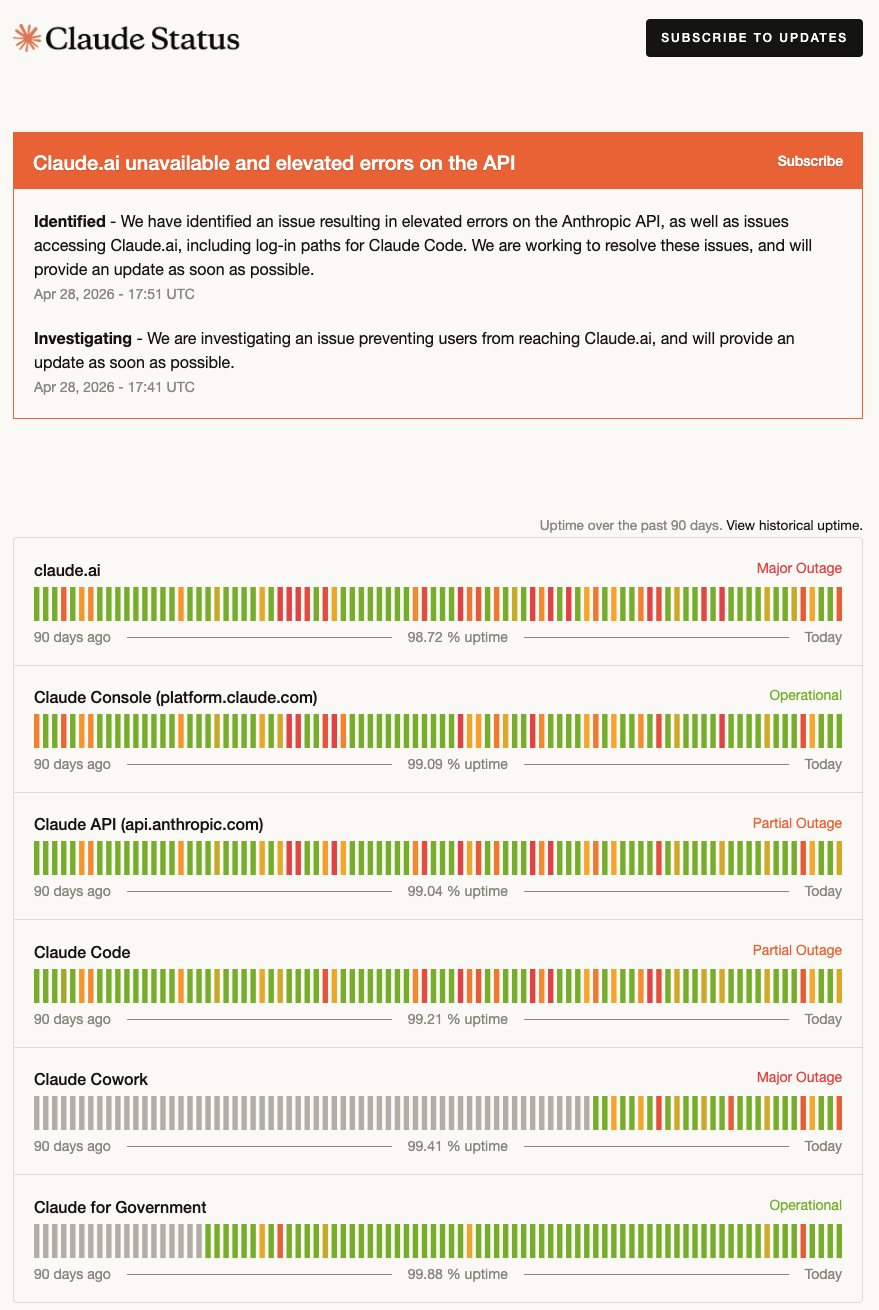
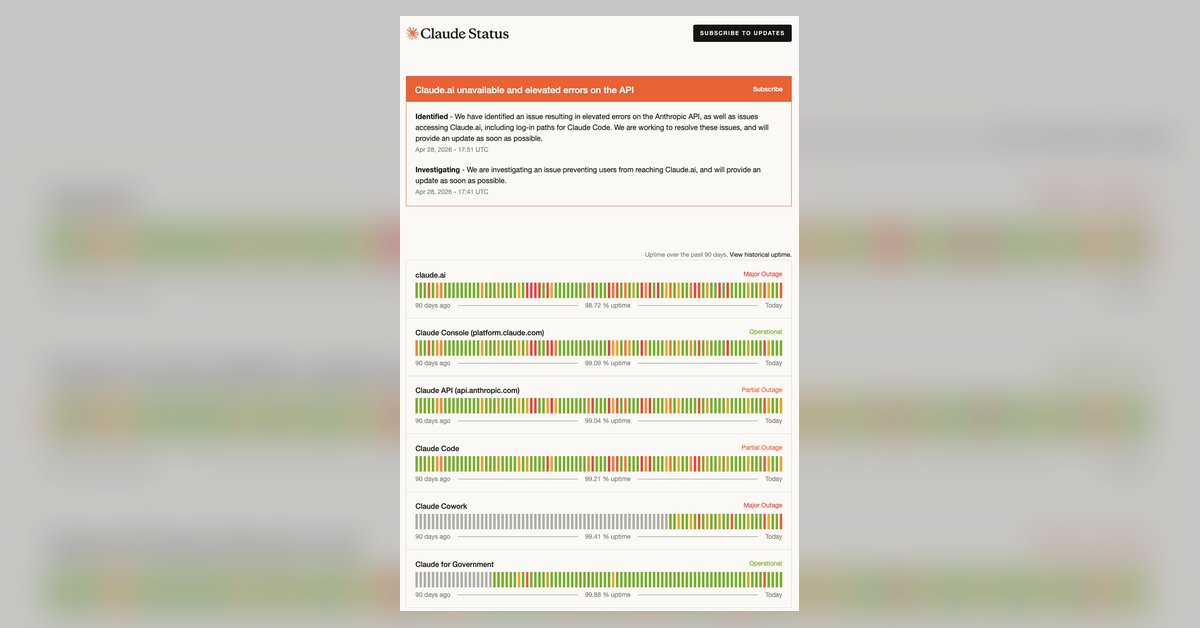
To be clear, this is not a criticism of Claude. Claude is an excellent AI system, and we use it often. The point is simpler: no AI provider is immune from outages, capacity spikes, rate limits, authentication issues, product changes, or model regressions. On April 28, 2026, Anthropic’s status page reported elevated API errors and access issues across Claude.ai, Console, API, Code, Cowork, and Government. Anthropic’s API documentation explains that 529 means the API is temporarily overloaded and can happen when APIs see high traffic across users.
For small businesses, the lesson is not “avoid AI.” It is “build AI like a business system, not a favorite app.”
Vendor Loyalty Is Not an Operating Model
Most small businesses start with one AI tool because that is the easiest path. Open an account. Create a workflow. Get a few quick wins.
But once AI starts running real business work, single-provider dependency becomes operational risk. If proposals, follow-ups, content, reporting, and internal research all depend on one model being available, your continuity plan is basically hope.
The market is moving toward AI that executes workflows, not just AI that answers questions. Gartner predicts that by 2028, many enterprises will favor platforms that commit to workflow outcomes, where humans supervise systems that act within policy and identity constraints. Gartner also notes that multiagent systems help organizations break complex work into specialized agents, improving scalability and reducing the limits of monolithic AI.
If the future is agentic, then resilience has to be designed into the agentic layer.
What AI Agnostic Actually Means
AI agnostic does not mean treating every model as identical. Some models are better at writing. Some are better at coding. Some are faster, cheaper, or stronger with long context.
The goal is to separate your business workflow from any one model provider.
In practice, that means your business process should say, “Draft this report,” “Classify these support messages,” or “Check this invoice packet for missing information.” It should not say, “Only Claude can do this,” “Only ChatGPT can do this,” or “Only Gemini can do this.”
Your workflow should define the business outcome. Your orchestration layer should decide which provider, model, fallback, retry path, or human checkpoint is appropriate.
That is where our JS Agentic approach fits.
JS Agentic is designed around practical small-business operations: plain-language agent instructions, cloud content storage, structured workflows, and provider flexibility. The point is not to chase every model announcement. The point is to keep the business moving. If one provider is degraded, the system can retry, route work to another model, queue non-urgent tasks, or escalate to a human with context preserved.
That is basic operational discipline applied to AI.
The Small Business Advantage
Large enterprises often need months of governance meetings before changing architecture. Small businesses can move faster. That speed matters because AI adoption is no longer theoretical. McKinsey’s 2025 State of AI research found that most organizations are using AI and 62% are at least experimenting with AI agents. PwC’s 2026 AI Performance Study found that the companies capturing the most AI value are more likely to redesign workflows around AI rather than simply add tools.
That is the small business opportunity: do not bolt AI onto broken workflows. Redesign around resilience, accountability, and measurable outcomes from the beginning.
Recommendations to Consider
Start with the workflows that matter most. Identify the AI-assisted processes that would hurt if they stopped for two hours.
Document the outcome, not the tool. Define the output, quality checks, and human review points.
Use at least two provider paths for important work. You do not need every model. You do need a fallback for critical workflows.
Build graceful degradation. Some work can wait. Some work can use a cheaper or faster model. Some work needs human review. Decide before the outage.
Track reliability like a business metric. Log failures, retries, provider switches, costs, and completion quality.
The businesses that win with AI will not be the ones with blind loyalty to one provider. They will be the ones that build adaptive systems around their own operations.
AI is powerful. Providers are fallible. Your business should be resilient.
That is why AI agnostic is the only way.
Ready to make your AI workflows resilient? Let’s talk.