


I don’t do the work anymore. I run the team that does.
In July we published Architecting the AI-Native SMB. We wrote it while living it and teaching clients to do the same. That same week, our AI team put it to a real test.
AI capability keeps compounding: the length of task frontier AI can complete has been doubling roughly every seven months. Each new model release is like a new hire with skills nobody on the team had last month. For a small business, augmenting people with AI is now the only realistic way to keep up.
Even with AI on your side, you hit a new limit fast: human attention is the bottleneck.
The Feature Worked. The Bill Didn’t.
On July 6 my agentic team designed, built, tested, and shipped a new live-view feature for our FX platform. It worked as intended.
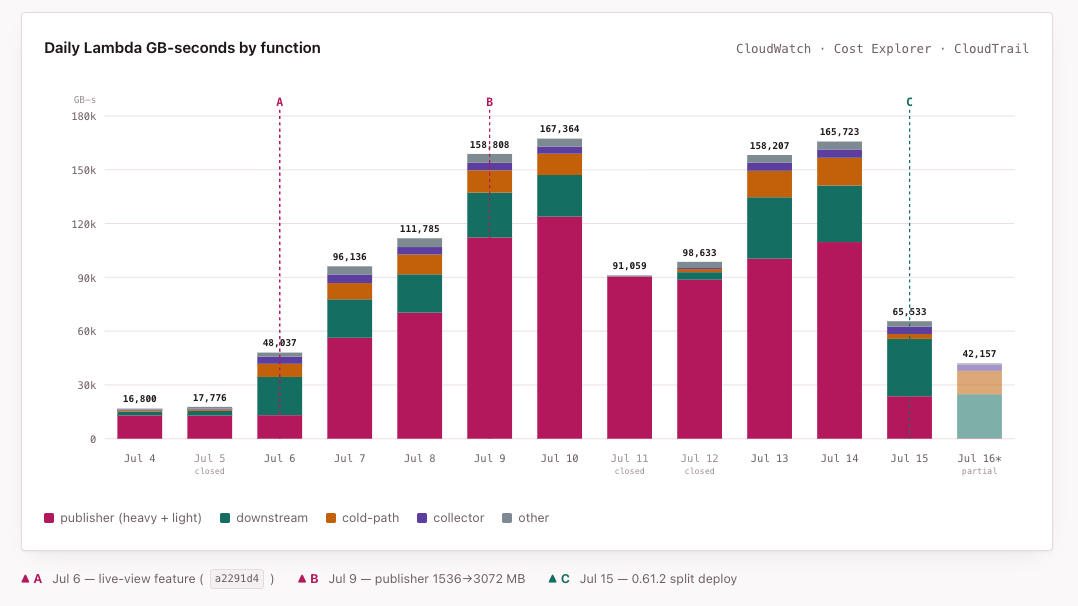
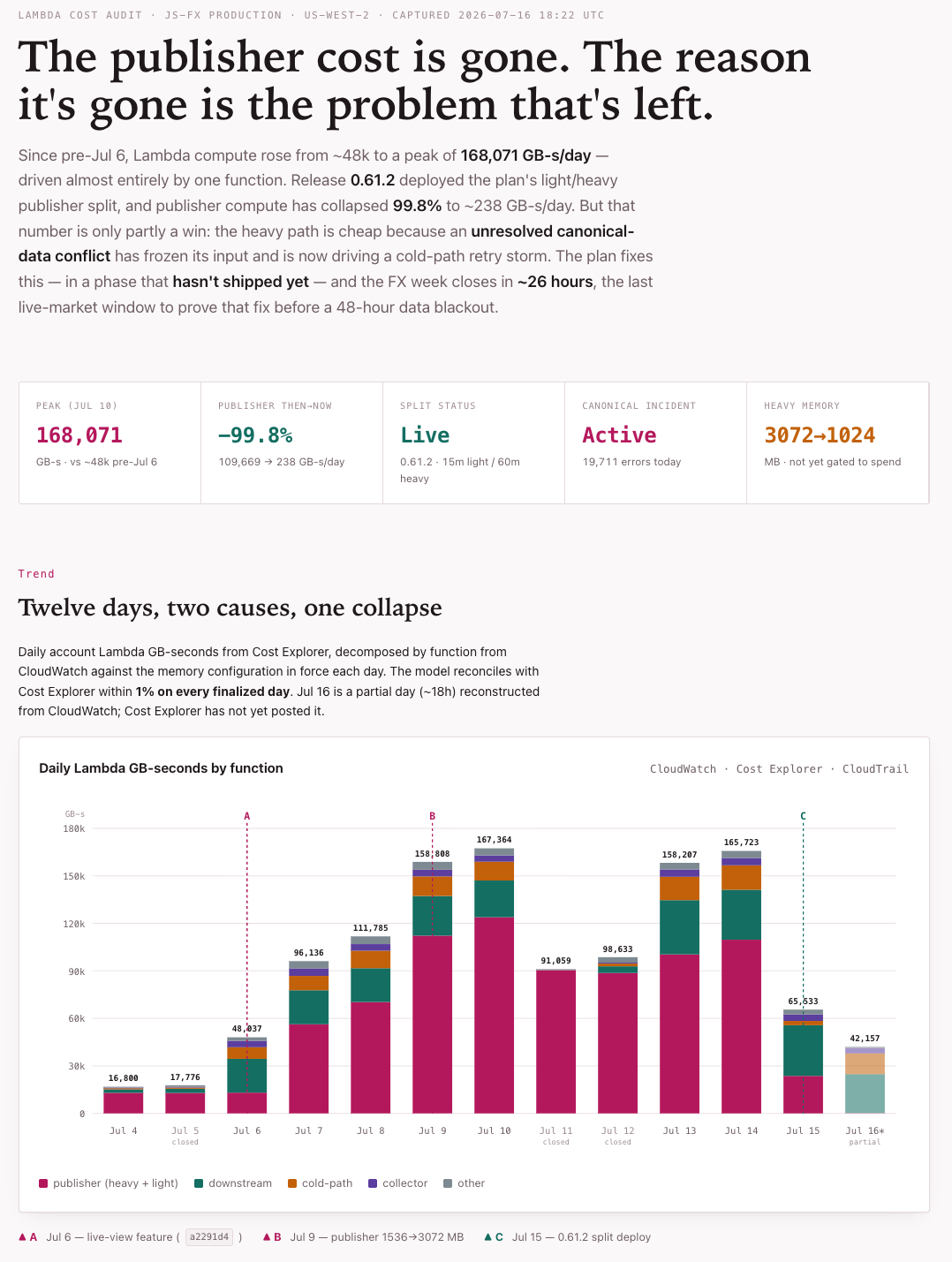
Four days later, the AWS usage report told a different story. Daily Lambda compute had climbed from a normal 48,000 GB-seconds a day to a peak of 168,071, a 3.5× jump nobody had approved. (Lambda bills by memory × time.)
The old me would have dropped everything to debug it. Instead, I gave one agent read-only AWS access and one instruction: use empirical data to identify the root cause.
It came back with receipts, not theories: a cost model that matched the real bill within 1% on every finalized day. The findings:
- The new feature recomputed 120 days of history every 15 minutes, whether or not anything had changed.
- Our “speed fix” had made it worse. On July 9 we’d doubled that function’s memory from 1536 to 3072 MB. Lambda scales CPU with memory, but this job spent its time waiting on storage, so we paid 2× for a 3.6% speedup.
- The proof was a Saturday. On July 11 the FX markets were closed and every other function sat idle, yet this one function still burned 91,059 GB-seconds recomputing reports on data that hadn’t changed.
Pass the Baton
From there the work moved from agent to agent. A planner drafted the fix, a builder implemented it, and a tester wrote the checks. On July 15, release 0.61.2 split the job into a light 15-minute check and a heavy hourly run that skips the work when its inputs haven’t changed. Memory went back down too, to 1024 MB.
The function’s daily compute went from 109,669 to 238 GB-seconds, a 99.8% drop.
The Employee Who Said “Not Yet”
I was ready to post the win. The reviewing agent wasn’t.
It found that the heavy job was cheap for the wrong reason. A data conflict upstream had frozen its input, so it was correctly skipping work on stale data while another function spun in a retry storm, logging 19,711 errors that day. In the reviewer’s words: you cannot yet distinguish “the split made heavy cheap” from “heavy has nothing to do because its input is broken.”
It also flagged the clock: the FX week closed in about 26 hours, the last live-market window to prove the fix before a 48-hour data blackout.
That one catch is why we have agents check each other’s work.
What My Job Actually Is Now
It’s mostly management:
- Onboarding new hires. Each model thinks, communicates, and fails differently. Our AI-agnostic JS Agentic Harness lets us put the best model on each job, but we still have to learn each one.
- Handoffs. Clear inputs and outputs, so context isn’t lost between agents.
- Cross-validation. One employee’s job is to disprove another’s.
- Direction. Keeping the team pointed at the right problem, not just one that’s moving.
Microsoft calls this role the “agent boss”. Anthropic’s own research found developers use AI in about 60% of their work but can fully delegate only 0–20% of tasks. Faros AI found heavy AI adoption raised throughput 33.7% while median time in review rose 441.5%.
Generation is cheap now. Your attention is the scarce resource. Protect it.
Five Things to Try This Week
- Give every agent a job description: its role, inputs, outputs, and what counts as done.
- Pair a builder with a different reviewer, ideally a different model.
- Require receipts. Ask for reconciled numbers and stated caveats, not confident prose.
- Set guardrails your attention doesn’t have to enforce, like AWS Cost Anomaly Detection. Wasted cloud spend rose to 29%, driven by AI workloads.
- Trial each new model on your own workloads before you trust it with them.
It’s exciting and daunting at once. You spend less time doing the work and more time leading the team that does it.
Ready to build an AI team that shows its work? Let’s talk.
Sources
- Measuring AI Ability to Complete Long Software Tasks — METR (arXiv)
- The 2025 Annual Work Trend Index: The Frontier Firm Is Born — Microsoft
- 2026 Agentic Coding Trends Report — Anthropic
- The AI Engineering Report 2026: The Acceleration Whiplash — Faros AI
- Flexera Finds Cloud Value Is Rising While AI Waste Grows — Flexera
- AWS Lambda Pricing — Amazon Web Services
- Configure Lambda Function Memory — AWS Documentation
- AWS Cost Anomaly Detection — Amazon Web Services
- Architecting the AI-Native SMB: Systems Engineering, Agentic Harnesses, and the March of Nines — Jeffrey Stop
- The JS Agentic Framework: Enabling SMB AI-Native Operations — Jeffrey Stop
- AI Agnostic Is the Only Way — Jeffrey Stop