

Something shifted this week that every small business owner should pay attention to.
Anthropic overtook OpenAI as the #1 provider in workplace AI adoption — the first time a competitor has held that position in the AI era. The same week, Anthropic launched Claude for Small Business: 15 ready-to-run agentic workflows that plug directly into QuickBooks, PayPal, HubSpot, Canva, and Google Workspace — built specifically for owners running operations solo or with lean teams. A 10-city, hands-on training tour launched simultaneously.
This isn’t a coincidence. It’s a signal. The largest AI provider in workplace adoption just made small business its explicit priority.
And the timing is not accidental.
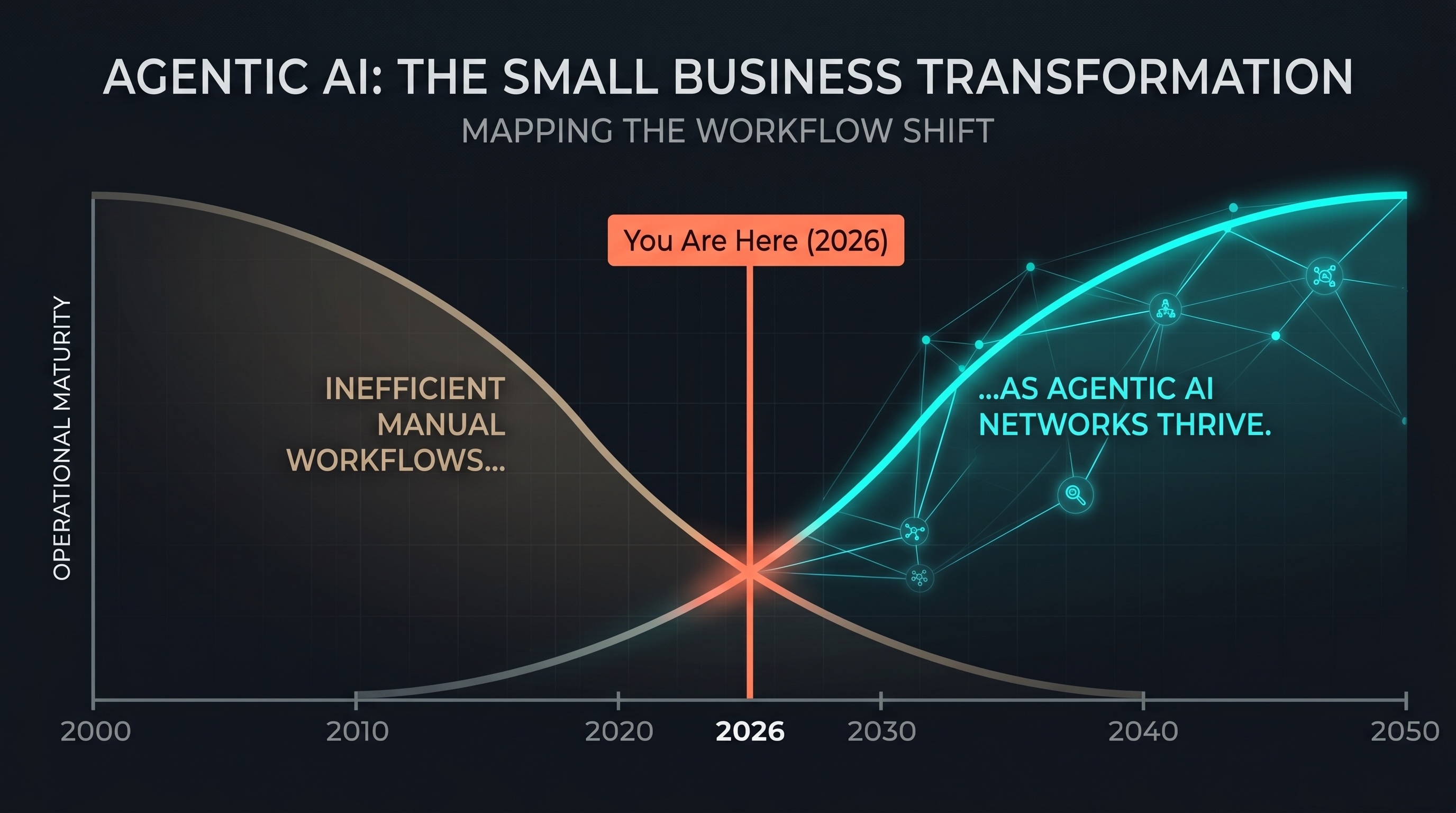
Futurist Peter Leyden calls this moment The Great Progression. His thesis: 2025 is the precise inflection point where the systems that defined the 20th century break down and the systems that will define the 21st century take hold. Three transformative technologies — AI, clean energy, and bioengineering — are hitting their S-curve tipping points simultaneously, and it only happens once every 80 years. “The old systems that defined the 20th century are rapidly breaking down,” Leyden writes, “while new systems that will define the entire 21st century are just being born.” The agentic shift in how businesses operate — how they hire, what software they buy, how work gets done — isn’t a trend. It’s a system change. And the companies thriving in the new system are the ones that stopped defending the old one.
What Enterprises Have Already Done — And Are Still Doing
For the past 18 months, the same story has been playing out across every major industry: profitable companies are cutting staff and slashing software costs because AI makes a smaller, more capable workforce possible.
- Salesforce reduced its customer support team from 9,000 to 5,000 — not because business was slow, but because agentic AI now handles roughly 50% of customer interactions.
- Block cut 40% of its workforce — 4,000 employees — while recording $2.87B in Q4 gross profit. Their CFO’s reasoning: “move faster with smaller, highly talented teams using AI to automate more work.”
- Cloudflare and Atlassian both cited the “agentic AI era” directly in their 2026 workforce restructuring announcements.
- Amazon’s CEO Andy Jassy publicly pledged to use AI to reduce the company’s total corporate workforce — while revenue keeps climbing.
Over 150,000 tech workers have been displaced by AI-driven layoffs in 2025–2026 alone. This is not a future threat. It is present reality.
Small Businesses Are Already Running the Same Playbook
Small businesses are following suit — and the results are specific.
Spencer Handley runs Sonora, an online guitar school. When Claude Opus 4.5 launched in late 2025, he moved fast. His 12-person sales team is now 1. His 48-person company is now 30 — without a drop in revenue. He replaced HubSpot, Calendly, Vimeo, and DocuSign with AI-customized tools, saving roughly $250,000 per year. His verdict: “We actually get slightly better results, and we don’t have to worry about managing people.”
Hospitable, a 140-person short-term rental platform, increased AI spending by 50% — the equivalent of three full-time hires. Without that investment, their support team would have needed to triple from 65 to nearly 200 people to keep up with growth. Instead, AI agents now generate 90% of the company’s code and answer 70% of customer support queries.
These aren’t enterprises with armies of engineers. These are lean businesses that made a decision and moved.
Gartner projects 35% of point-product SaaS tools will be replaced by AI agents by 2030. The unbundling is already underway — and small businesses are leading it.
SMBs Have a Structural Advantage — If They Move Now
Here’s what rarely gets said out loud: small businesses are better positioned for agentic AI than large enterprises.
No legacy systems. No lengthy procurement cycles. No 12-layer approval chains. Lean teams can reorganize around new technology in weeks, not quarters. Harvard economist David Deming put it plainly in 2025: “AI adoption is faster in smaller firms, including startups.”
Databricks reported a 327% spike in multi-agent system deployments over just four months in 2026. The inflection point isn’t approaching. It already happened. The businesses winning right now aren’t the ones with the biggest IT budgets — they’re running blended workforces where humans handle judgment calls and AI agents handle execution chains, compounding the advantage every single day.
What “Agentic” Actually Means for Your Business
Agentic AI isn’t another chatbot. It doesn’t wait to be asked. It takes initiative, executes multi-step workflows, makes decisions within defined parameters, and operates 24/7/365 — whether you’re in a client meeting, on a run, or asleep.
For a small business, that means:
- Operations reports that write themselves
- Invoice follow-ups that go out automatically
- Content drafted, reviewed, and scheduled without a human in the loop
- Customer inquiries triaged and responded to around the clock
As we wrote in Survival Is Optional. Change Is Not Required.: the businesses that survive won’t be the most excited — they’ll be the ones that committed with constancy of purpose and showed up every day. Agentic AI is the infrastructure that lets that discipline scale.
This Is the Wake-Up Call
The enterprises you’ve watched cut staff and software costs while posting record profits? They aren’t doing anything you can’t do.
The gap between a major enterprise deploying agentic AI and a small business doing the same isn’t sophistication. It’s speed. And small businesses can move faster.
At Jeffrey Stop, we’ve built this from both sides. With enterprise-grade experience designing, implementing, operating, and governing hybrid agentic systems — and an SMB-ready framework in JS Agentic that deploys custom AI agents in under 30 minutes with no coding required — we work at exactly this intersection.
Our Three-Tier Workforce Framework moves entire teams from AI-resistant to AI-native. Our Managing Intelligence approach means your existing leadership skills are already your biggest AI advantage. And our agentic teams architecture delivers enterprise-grade results at small business price points — the same systems our own agents use to run production operations for less than $0.33/day.
The signal is clear. The tools are ready. Leyden’s new system is already here — and it runs on agentic AI.
The question isn’t whether this shift is coming for your industry.
It already has. The only question is which side of it you’re on.
Ready to explore what agentic AI can do for your business? Let’s talk.
Sources
- Anthropic Overtakes OpenAI in Workplace AI Adoption — Axios
- Introducing Claude for Small Business — Anthropic
- The Small Businesses Already Replacing Workers With AI — TIME
- Companies That Have Replaced Workers with AI in 2025 and 2026 — Tech.co
- 20,000 Job Cuts at Meta, Microsoft Raise Concern That AI-Driven Labor Crisis Is Here — CNBC
- 150K+ Tech Jobs Cut in 2026 — Tech Insider
- AI Agents Are Disrupting SaaS — What It Means for Enterprise — Built In
- Agentic AI for Small Business: What It Actually Does — Glivera
- Survival Is Optional. Change Is Not Required. — Jeffrey Stop
- Meet JS Agentic: Your Small Business Just Got an AI Team — Jeffrey Stop
- AI-Native, AI-Curious, AI-Resistant: Three-Tier Workforce Framework — Jeffrey Stop
- Managing Intelligence: Why Your Leadership Skills Are Your AI Advantage — Jeffrey Stop
- How Our AI Agents Built a Daily News Engine for Small Businesses — Jeffrey Stop
- What Is The Great Progression: 2025 to 2050? — Peter Leyden
- The Great Progression: 2025 — Big Think