



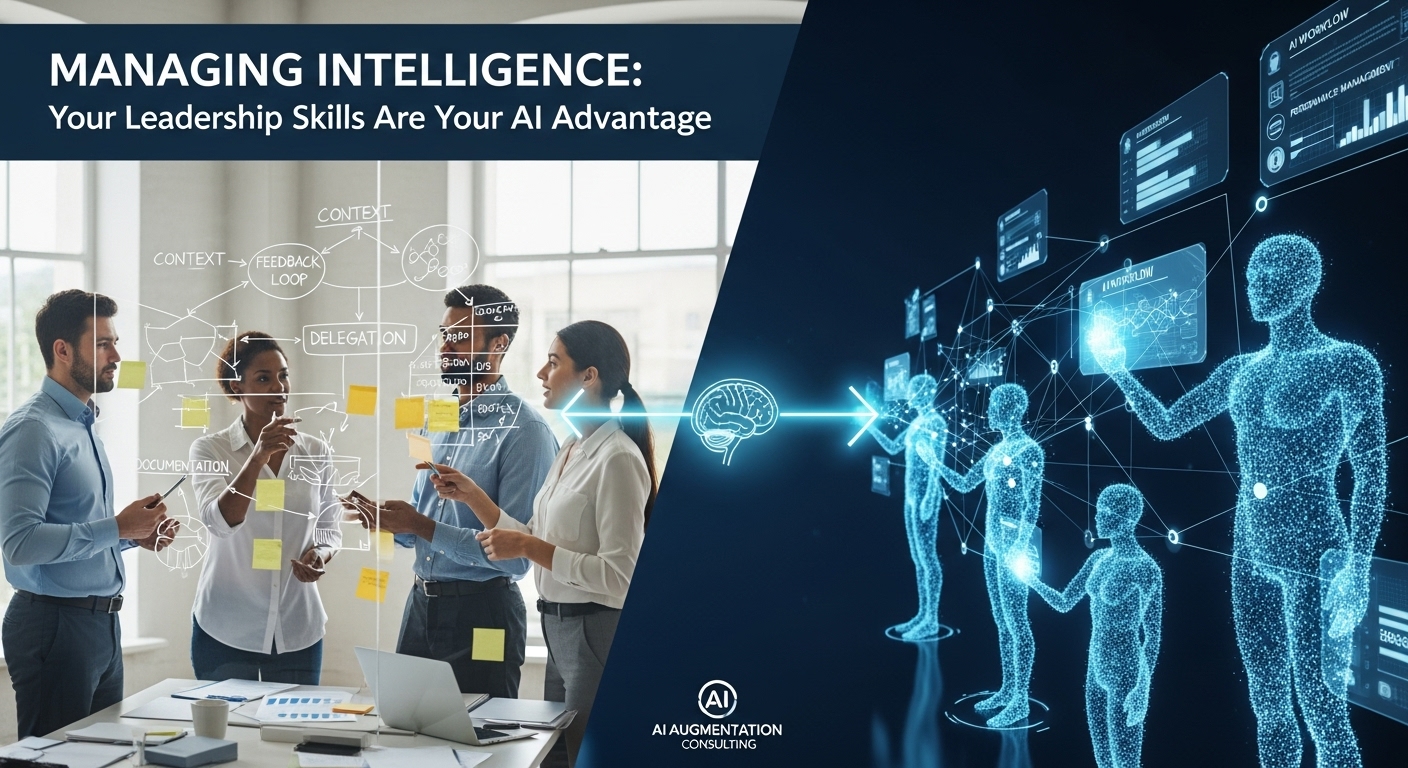
Managing Intelligence: Why Your Leadership Skills Are Your AI Advantage
Artificial intelligence is a derivative of human intelligence.
This single insight is the key to AI success—and it’s why your existing leadership skills are more valuable than any technical training.
AI systems weren’t invented in a vacuum. They emerged from decades of cognitive science research studying how humans think, learn, and solve problems. Neural networks mirror brain architecture. Machine learning echoes how we learn from experience. Context windows reflect working memory limitations.
This isn’t a coincidence. It’s inheritance.
And it means the systematic approaches that work for managing human intelligence also work for managing artificial intelligence.
The Systematic Approach to Any Intelligence
Knowledge management research confirms that success with any intelligent system—human or artificial—requires the same core elements:
- Clear context and objectives: Both humans and AI perform better when they understand the goal and have relevant background
- Structured reinforcement: Critical information must be repeated and emphasized, not mentioned once and forgotten
- Feedback loops: Continuous improvement requires measurement and adjustment
- Documentation systems: Institutional knowledge needs to be captured and accessible
Organizations that adopt these systematic approaches see 37% reduction in information search times and 45% improvement in retrieval accuracy—whether the “employee” searching is human or digital.
The businesses struggling with AI adoption are often the same ones struggling with human knowledge management. The solution isn’t more AI training—it’s better intelligence management across the board.
The Proof: Context Rot and Human Memory Loss
Here’s a concrete example of how human and artificial intelligence share the same limitations—and solutions.
In the 1880s, German psychologist Hermann Ebbinghaus discovered the “forgetting curve“—humans lose approximately 50% of new information within an hour and up to 90% within a month without reinforcement. This is why employee onboarding programs emphasize repetition, documentation, and regular check-ins.
AI agents face a remarkably similar challenge called context rot. As conversations grow longer, AI systems experience attention dilution—earlier information gets “forgotten” as newer inputs take priority. Even the most advanced AI models with massive context windows eventually hit limitations where early instructions fade from effective recall.
The solution for both? Reinforcement and structure.
Just as you’d provide written SOPs (Standard Operating Procedures), regular reminders, and clear documentation for a new hire, AI agents thrive when given structured memory systems, repeated context cues, and well-organized instructions. The management technique is identical—only the medium changes.
From People Management to Agent Management
This parallel extends across virtually every aspect of intelligent coordination:
Delegation and Autonomy: Research on the Tannenbaum-Schmidt Continuum shows that effective delegation requires matching authority levels to demonstrated competence. The same applies to AI agents—you grant more autonomy as they prove reliable on simpler tasks. Start narrow, then expand.
Context and Communication: Studies in human-AI collaboration reveal that “information asymmetry” directly impacts outcomes. Just as unclear instructions derail human employees, AI agents underperform when given vague or incomplete context. Clear communication matters regardless of whether your team member is human or digital.
Performance Management: “Managers will need a plan to manage performance and make decisions based on the actions of both AI and humans,” notes Dr. Mindy Shoss, Psychology Professor at the University of Central Florida. The evaluation frameworks are converging.
McKinsey’s recent research on “agentic organizations” confirms this trend: companies thriving with AI aren’t those with the most technical expertise—they’re the ones applying proven organizational principles to their digital workforce.
Why This Matters for Your Business
A PwC survey from April 2025 found that 79% of companies already use AI agents, with 88% planning to expand their investments within a year. The businesses gaining competitive advantage aren’t waiting for the technology to get “easier”—they’re recognizing that their existing leadership skills transfer directly.
Consider:
- Onboarding: The process of orienting an AI agent to your business context mirrors onboarding a human employee
- Knowledge Transfer: Creating documentation and SOPs serves both human and AI team members
- Feedback Loops: Regular performance reviews apply whether evaluating human output or AI-generated work
- Change Management: The organizational psychology of adopting new team members applies equally to adopting AI
The difference is that AI agents can work 24/7/365, don’t take vacation, and scale instantly once properly configured—delivering enterprise-grade results at small business price points.
Your Next Step
The question isn’t whether you’re “technical enough” for AI. The question is whether you’re ready to apply the management skills you’ve already developed to a new kind of team member.
If you can manage people, you can manage AI agents. The frameworks are the same—delegation, context, feedback, reinforcement. You’ve been practicing these skills for years.
The small businesses that will thrive in the AI era aren’t the most technical. They’re the ones that recognize the leadership abilities they already possess—and put them to work.
Ready to explore how your existing management skills can unlock AI value for your business? Let’s talk about your AI journey.
Contact us: https://jeffreystop.com/contact/
Supporting Sources
-
McKinsey - The Agentic Organization: Contours of the Next Paradigm for the AI Era
-
PwC Survey (April 2025) - 79% of companies already use AI agents; 88% expanding budgets (Referenced in: arxiv.org)
-
IBM - What Is AI Agent Memory?
-
TechTalks - Beyond Context Windows: How the Memory of AI Agents Is Evolving
-
Frontiers in Organizational Psychology - Trust and AI Weight: Human-AI Collaboration in Organizational Management Decision-Making
-
Dr. Mindy Shoss quote - University of Central Florida, Psychology Professor (Referenced in: Fortune)
-
PMC/Frontiers in Neuroscience - Cognitive Psychology-Based Artificial Intelligence Review
-
MDPI Computers - Artificial Intelligence and Knowledge Management: Impacts, Benefits, and Implementation
-
Frontiers in Artificial Intelligence - Navigating the AI Revolution: Challenges and Opportunities for Integrating Emerging Technologies into Knowledge Management Systems
Jeffrey Stop specializes in AI business transformation for small businesses and creators, helping teams unlock enterprise-grade automation at accessible price points. With 16+ years of enterprise experience and hands-on AI development expertise, we make sophisticated AI practical and profitable.